


Cold email for small business: a 14-day plan

Cold email is one short, personal email to a business that has never heard of you, followed by three replies in the same thread over 14 days. It works when every email is written for one person, built on something true about their business, and asks for one small thing.
You finish this guide with a first email, a follow-up plan and a sending setup that lands in the inbox.
When does cold email work?
Cold email works when the reader already buys what you sell and you show them a reason to buy it from you this month. A roof inspection to a property manager with 40 buildings works. A newsletter to a list of strangers doesn't.
Check three things before you write to a business. It is working right now: the business register shows filings this year, the reviews are recent, the site was edited this year. It buys your kind of work: a management company buys roof repairs, a single-flat landlord doesn't. And you know one fact about them that you found yourself.
Who should you write to?
You write to the one person who decides, at their business address, with the business's general inbox in copy. Three recipients at most, in one email and one thread.
Find the decider in the business register: the board member or director. Then confirm the same name on the business's own website or its Google profile, so you know the person still runs it. Most service-business websites show only a role inbox such as info@ and no named person, so the name comes from the business register.
Never send the same email separately to three addresses at one business: three copies read as a mail merge and split the replies.
Run every address through an email verifier before the first send, and keep your bounce rate under 2%. Keep a role address such as info@ when the verifier confirms the mailbox exists: it is the inbox you copy.
How do you write a cold email that gets a reply?
You write a cold email in six parts: a short lowercase subject, a first line about them, proof in their own numbers, a risk reversal, one useful thing you made for them and one soft ask. It stays under 70 words and fits on a phone screen without scrolling.
Here is a worked example. Mart runs a roofing firm in Tartu and writes to Liis, the property manager at a company that looks after 40 apartment buildings in the city.
Subject: annelinn roof
Hi Liis,
I walked past your Annelinn block this morning: 14 lifted sheets on the north slope, right above the stairwell.
The building register says 1972, so it's the original bitumen roof, and it lets water in at the March snowmelt.
If my inspection finds nothing that needs fixing, it costs you nothing.
I filmed 60 seconds of it from the street for you. Mind if I send it over?
Mart Mart's Roofing, Tartu
Not the right person? Reply "no" and I won't write again.
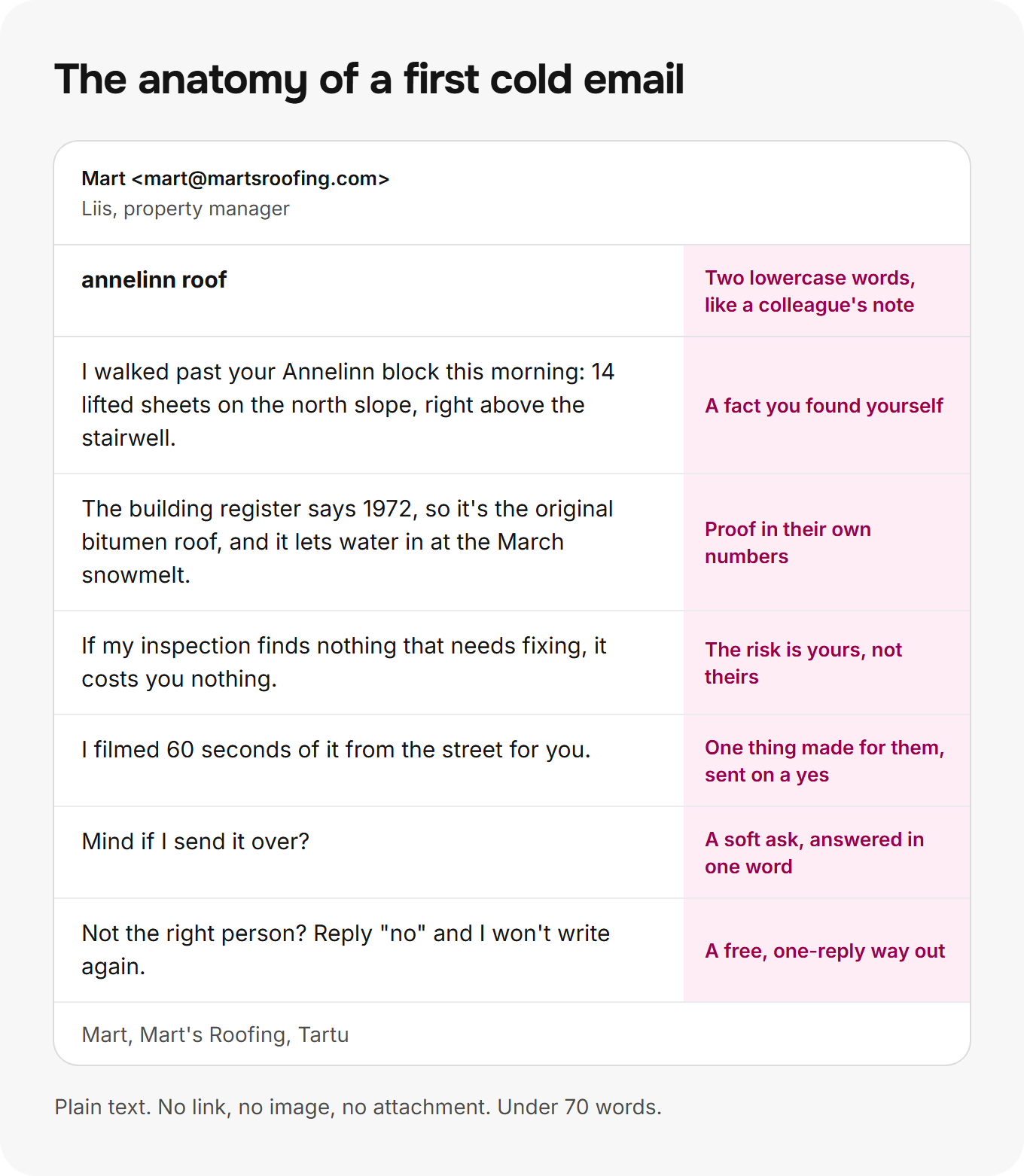
Every line does one job. The subject is two lowercase words, the way a colleague titles a note. The first line proves Mart looked, with a count nobody else has. The building's year and roof type are proof in her own numbers, and the free inspection takes the risk off her. The ask costs her one word: a "yes" gets the video, and the call comes after it.
The numbers in your email are ones you measured or read yourself. A figure you never checked about someone's own building is the fastest way to lose them.
What do you send with the first email?
You send nothing yet: you offer one thing made for that business and send it when they say yes. A 60-second phone video, two photos with a note, or a one-page quote. The first email carries no link, no image, no attachment and no tracking pixel.
A "yes" gets a reply in the same thread with the video link and the call ask: 10 minutes on a named day, with no commitment in it. A video recorded at their address shows work no mass mailing contains.
Keep every email in plain text, signed with your first name and your business, with no logos or banners. Count replies, not opens: an open count needs a hidden image in the email, and the first email carries none.
How do you follow up?
You follow up three times in the same thread over 14 days, each time with one new reason to reply, and you stop the moment they answer. Reply-all, so the copied inbox sees every step.
| Day | What you send | The new reason |
|---|---|---|
| Day 0, Tuesday morning | The first email | The fact, the free inspection, "mind if I send it over?" |
| Day 2, Thursday | Two lines, same thread | The video link itself and a day for the call |
| Day 7, Tuesday | Three lines, same thread | One more fact: a second building of theirs, or the price of a repair now against after a leak |
| Day 14, Tuesday | Two lines, same thread | Closing the loop: "I'll stop here. The offer of a free inspection stands until the end of the month." |
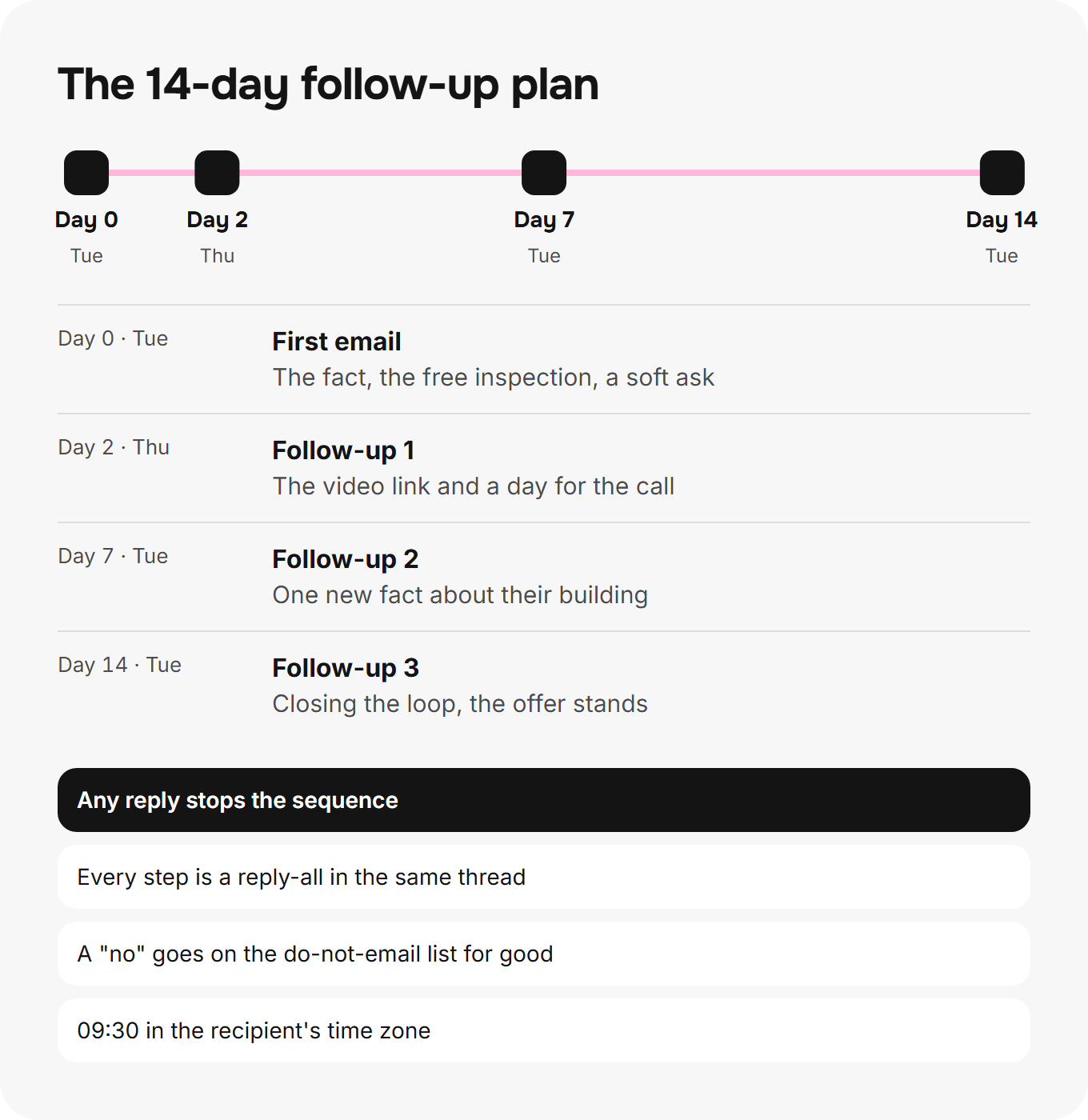
A "no" ends it for good. Put that business on a do-not-email list the same day and keep the list forever.
How do you set up the sending side?
You send cold email from a second domain in your business's name, never from your main one, with SPF, DKIM and DMARC set, two inboxes on it and at least 14 days of warm-up before the first cold email. Your main domain keeps sending quotes and invoices, untouched by any complaint.
Buy a domain close to your own (martsroofing.com next to martsroofing.ee), point it to your main site, open two mailboxes on it and set the three records your email provider lists:
- SPF names the servers allowed to send your mail.
- DKIM signs each email so the receiving server knows nobody changed it.
- DMARC tells receiving servers what to do with mail that fails both, and sends you reports.
Google's sender rules ask every sender for SPF or DKIM and a spam-complaint rate below 0.3%, and Google recommends staying below 0.1% (Google email sender guidelines). Bulk senders of more than 5,000 emails a day to Gmail also need DMARC and one-click unsubscribe; Yahoo asks the same and has unsubscribes honoured within 2 days (Yahoo sender best practices). Two inboxes at 30 a day are far from bulk. Set all three records anyway: they cost nothing and mark you as a real sender.
Spend the first 14 days writing to people who know you: suppliers, past customers, your accountant. Their replies build the new mailbox's history. Then send 15 cold emails a day from each inbox, every one worded on its own, and add 5 a week while bounces stay under 2% and nobody complains. A Google Workspace inbox stops at 30 a day; a bulk Outlook inbox stops at 5. Warm-up mail counts inside that number, never on top of it: an inbox at 30 that sends 20 cold emails sends 10 warm-up notes at most. Send in the recipient's Tuesday to Thursday morning, at 09:30 their time.
To send more, add a domain with two inboxes of its own and never raise the number per inbox. Keep one spare domain warming in the background, so a blocked domain doesn't stop your sending for the 14 days a new one needs.
Check the sending side every week. Send one email from each inbox to addresses you own at Gmail and Outlook, and see whether it lands in the inbox or in spam. Read every bounce: "no such user" means the address is dead, so remove it for good; "blocked" or "low reputation" means the receiving server distrusts your domain, and the address is still good. Bounces over 2% in a week stop the sending until you have checked the list and the inboxes. A blocked domain rests for 8 weeks while the spare takes its place.
What does the law allow?
In Estonia you email a company at its business address without prior consent, as long as you say who you are and give a free, easy way to refuse in every email. A private person's address needs their consent first.
| Estonia | United Kingdom | |
|---|---|---|
| A company's general address (info@) | Allowed with a free opt-out in every email | Allowed to any corporate body |
| A named person at a company | Allowed when the offer fits their role and decision power; they object at any time and you stop | Allowed for corporate subscribers; data protection law applies to the name |
| A private person | Prior consent needed | Consent needed; sole traders and some partnerships count as individuals |
| Every email | Your identity and a free way to refuse | Your identity and a valid address to opt out |
The Estonian rule is § 103¹ of the Electronic Communications Act: a legal person's address is used for direct marketing when each email offers "a clear and distinct opportunity" to refuse "free of charge and in an easy manner", and never after a refusal (Electronic Communications Act, Riigi Teataja). The Data Protection Inspectorate counts a named work address such as mari@company.ee as the company's when your offer fits that person's role and decision power, and as a private person's otherwise (AKI guide to electronic direct marketing). The name is personal data under the GDPR, which lists direct marketing among legitimate interests (GDPR Recital 47); the person objects at any time and the objection ends it (GDPR Art. 21). In the UK, sole traders and some partnerships are treated as individuals (ICO guide to email marketing).
The opt-out line in Mart's email meets both. This is a summary of the rules on 15 November 2026, not legal advice for your case.
Frequently asked questions
Is cold email legal?
Yes, to companies. In Estonia you email a company's business address with your name and a free opt-out in every email; in the UK you email any corporate body. Private people, UK sole traders and some partnerships need their consent first.
How many cold emails should you send a day?
Fifteen a day per inbox to start, from an inbox that spent 14 days sending ordinary mail first, and never more than 30 on Google Workspace. To send more, add a domain with two more inboxes instead of raising the number.
How many follow-ups should I send?
Three, on days 2, 7 and 14, as replies in the same thread. Each one adds one new reason to answer. Stop at the first reply of any kind, and stop for good after a "no".
Should I use a template?
No. Keep the six-part structure and write each email new: the first line, the fact and the thing you made differ for every business, and no two emails share the same sentences. A template sent to 200 businesses reads like one, to the reader and to the receiving server.
Where to start
Start with one business you'd most like as a customer. Find the decider in the business register, walk past or look up one fact about their building or their site, record 60 seconds on your phone, and send Mart's six parts on Tuesday at 09:30.
Cold email finds the customers you pick. The other half is being found by the customers who are already searching for your trade in your town. REND does that half for service businesses, with a guarantee: We guarantee 15 clients in 90 days, or a full refund. A free audit of your site shows where those enquiries go missing today and what to fix first.
 Edited by Andres LepikCo-founder & Head of Growth
 Fact-checked by Siim SaarHead of SEO
Post by Rasmus Kivi
Co-founder & CEO
Co-founded REND and still reads every client's monthly report himself before it goes out. He writes about what turns a search into a phone call for trades and service businesses.